Home  |  About Doosan  |  Investors  |  Careers  |  News & Media  |  Contact Us

Doosan History

From one man’s vision in 1896 to a global management team with over 39,000 employees in 35 countries, Doosan is one of the industrial giants changing the world’s landscape today.

The Foundation of our Success (1896~1949)

The Foundation of our Success (1896~1949)


Doosan took the first step in its legendary history in 1896 when Park Seung-jik opened a small, modern store in Baeogae, Jongro 4, Seoul. From this first store, we continued to build on that success. In 1946, Too Pyung Park, the successor to Park Seung-jik, changed the small store into the Doosan Store, heralding the beginning of Doosan's modern history.

1896 Park Seung-jik opened first store

1896

With the launch of Korea’s first modern store in Baeohgae on Jong-ro 4-ga in Seoul in 1896, the history of Doosan began.

1915 Started making Bakgabun, a cosmetic powder

1915

Pakgabun soon became the hottest “must-have” item for women in Korea in 1920’s.

1925 Changed the name of Park Seung-Jik Store Limited to Doosan Store

1925

As Doosan transformed into a corporation, we modernized our accounting system and began to market ourselves by producing and distributing promotional calendars and placing newspaper ads.

See Doosan at Work

The Power of Our People

The Power of Our People

Establishment of a Modern Management System (1950~1969)

Establishment of Modern Management System (1950~1969)


Doosan Trading’s business expanded as we founded OB in 1952.  In the 1960’s, our portfolio grew to include construction, foods and beverages, machineries, media, and cultural businesses.  This diversification became a strategic element of our growth and modernization.


1951 Established Doosan Trading Company (currently Doosan Corporation Glonet)
1951

The establishment of Doosan Trading Company laid a foundation for Doosan’s growth into one of the largest companies in Korea.

1952 Established Oriental Brewery
1952

Oriental Brewery was re-established in the aftermath of the Korean War, emerging later as a reputable international brewer with a diversified portfolio that included construction, machinery, glass, beverages, media, and trade businesses.

1960 Established Dongsan Construction and Engineering (currently Doosan Engineering & Construction)
1960

With the establishment of Dongsan Construction and Engineering, Doosan became an integral part of many projects that were part of the government's first "5-year Economic Development Plan", which started in 1962.

1960 Acquired Hapdong News Agency (currently Yonhap News)
1960

Hapdong News Agency (Yonhap News) is now the largest news agency in the country. In 1962, it served a pivotal part as the Korean media industry developed and began broadcasting news abroad.

1966 Founded Hanyang Food
1966

Funded exclusively by Dongyang Brewery, Hanyang Food was the first domestic bottler of Coca Cola.

1967 Founded Yoonhan Machinery (currently Doosan Engineering & Construction)
1967

With the establishment of Yoonhan Machinery, Doosan entered the machine industry, playing a key role in developing Korea’s infrastructure and taking the domestic machine industry to the next level.

1969 Founded Hankook Bottle and Glass
1969

To keep pace with the rapid growth of Oriental Brewery in the 1960’s, Doosan founded Hankook Bottle & Glass, which produced popular brands such as Parka Glass.

Expansion & Innovation (1970~1979)

Expansion & Innovation (1970~1979)


In the 1970’s, Doosan balanced growth and expansion with risk management.  Our partnerships with leading international companies focused on technological advancements, while at home we consolidated our businesses and emerged as a leader that was well-positioned for the 80s.


1974 Established Korea Oak Industry (currently Doosan Electro-Materials BG)
1974_1

Korean Oak Industry was established to produce copper clad laminates (CCL), which is one of the key materials in the electronics industry. First, we produced CCLs domestically, and then we targeted the global market.

1974 Established Doosan Development
1974_2

A pioneer in the livestock industry, Doosan Development is a general development company operating various businesses including cargo transport, aviation, printing, and salt production.

1975 Established Dongyang Agriculture (currently Doosan Tower)
1975

Dongyang Agriculture has set an example for other companies by contributing to regional communities and helping farmers increase their incomes by buying grapes, barley, and hops crops.

1978 Renamed OB Group as Doosan Group
1978_1

To create an integrated corporate image that represented the ever-diversifying businesses of the Group, the company was renamed after the “Doosan” of Doosan Industrial, which is a legal heir of our parent company, Park Seung-Jik Store.

1978 Established Yonkang Academic Foundation (currently Yonkang Foundation)
1978_2

The Yonkang Foundation was established after the death of the late Too Pyung Park, the first chairman of Doosan Group whose pen name was “YonKang.” The Foundation honors his conviction that “Education is the main engine that drives national development.

1979 Established Oricom Inc
1979_1

Oricom began as an advertisement planning division of the Hapdong News Agency in 1967. The first general advertising company in Korea, Oricom has produced numerous creative advertisements which have earned it the nickname of “Ad academy.”

1979 Established Doosan CCK Can Manufacturing
1979_2

By making a full-scale entry into the 355ml 2-piece aluminum can industry for the first time in Korea in 1981, the domestic carbonated beverage industry tried to diversify types of vessels by producing cans and PETs.

1979 Doosan Corporation attains US$ 100 million in export
1979_3

Doosan Corporation achieved annual export of US$108,228,754 on October 22, 1979 by diversifying export products and overseas markets.

Eye on the Environment (1980~1995)

Eye on the Environment (1980~1995)


Building on the success of the 1970s, Doosan focused on international competitiveness and greater technological investment in all of our businesses.  While we grew our businesses, we also kept our eye on the environment and were recognized as an eco-friendly company.


1980 Founded OB Seagram
1980

In 1980, OB Seagram began as the first domestic whiskey maker founded via a joint venture with Oriental Brewery, Seagram of the U.S., and the Chivas Brothers of Scotland.

1982 Formed OB Bears (currently Doosan Bears)
1982

OB Bears, the first Korean professional baseball team, won the trophy in the first Korean Series.

1983 Relocates head office to Doosan Building in Eulji-ro, Jung-gu, Seoul
1983

The construction of Doosan Tower Building measuring 9,500 pyeong (31,300 sq. meters) in total floor space with 21 floors above the ground and three underground floors was completed at the 101-1, Eulji-ro 1-ga, Jung-gu. Doosan Corporation moved into the 19th and 20th Floor of the building on May 28, 1983.

1985 1985 Acquired Donga Publishing (currently Doosan Dong-A)
1985_1

Donga Publishing, a leader of the Korean publishing and printing industry for 60 years, joined the Doosan family.

1985 Acquired Baekhwa Brewery
1985_2

Baekhwa Brewery was set up in Goonsan in the Northern Cheolla province at the end of Japanese colonialism in 1945. Beyond beer, the brewery also produced liquor.

1987 Established Doosan Cuvex Co., Ltd (currently Doosan Cuvex)
1987

Doosan Cuvex was established in 1987 to operate various leisure businesses including a golf club.

1988 Acquired Duksoo Development
1988

Duksoo Development, joined the Doosan family in 1988 and has continued to grow running construction, sports, and leisure businesses.

1990 Opened Chuncheon Country Club (currently Ladena GC)
1990

Doosan Cuvex opened the Chuncheon Country Club (currently Ladena GC) in 1990.

1991 Founded Doosan Training & Technology Center
1991

To further our goals of globalization, the center was set up to achieve technological advancements and implement systemized and sophisticated R&D projects.

1992 Set management goals and defined employee spirit
1992

New management goals such as customers, quality, innovation, and talent, and definitions of employee spirit, such as pride, professional, passionate, and positive, served as new standards for organizational management and guidelines for employee behavior.

1993 Opened Yonkang Hall (currently Doosan Art Center)
1993_1

Yonkang Hall was opened as a multi-purpose cultural venue on the centennial anniversary of Doosan at 270-beonji, Yeonji-Dong, Jonro 5-Ga, Seoul, an establishment formerly named “Yeon-mot-gol.” It was re-opened as Doosan Art Center in 2007.

1993 Acquired Kyungwol
1993_2

Doosan paved the way for our Soju business, the most popular distilled liquor in Korea, with the acquisition of Kyungwol, a native of Kangwon province.

1994 Introduced first annual wage system among Korean companies
1994_1

Doosan introduced the first annual wage system in Korea which helped facilitate a challenging and creative attitude among employees in their workplaces.

1994 Established Doosan Information & Communication (currently Doosan Information & Communication BU)
1994_2

Since being launched as Dongyang Computer Technology in 1970’s, Doosan Information & Communication has been providing customers with total solutions via comprehensive consulting focused on software for over 20 years.

1995 Recognized as Korea’s top company by Korea Guinness Association
1995_1

Doosan was certified Korea’s top company by the Korean Guinness Association ,officially recognizing 100 years of history since Seung-Jik Park opened the first store at 4-Ga in Jongro on August 1, 1896.

1995 Introduced “Backpacking to Europe” system
1995_2

The system gives employees the opportunity to broaden their knowledge and experience by freely traveling abroad for 10-to-15 days by providing them with roundtrip airplane tickets, a Eurail pass and more.

Restructuring for Continued Growth (1996~2006)

Restructuring for Continued Growth (1996~2006)


After our centennial in 1995, we looked ahead to the next one hundred years with our 2G strategy:  Growth of People and Growth of Business. We attracted foreign investment from around the world and saw dramatic growth in our infrastructure support businesses.


1996 Introduced large-unit teaming system
1996

To keep up with the full-scale overhaul of our business structure, the existing 907 departments and divisions were all dismantled. Meanwhile, small-unit teams that were in operation were integrated into 415 large-unit teams.

1996 Selected as eco-friendly company – breaking the previous record.
1996

22 out of 30 Doosan worksites were recognized as eco-friendly for three consecutive years, thus setting new records.

1996 Announced Doosan Group’s new CI
1996

After our centennial in 1995, we announced the new CI and looked ahead to the next 100 years.

1996 Celebrated Doosan’s 100th anniversary of our founding
1996

As the first Korean company to celebrate a 100th anniversary, Doosan reaffirmed our conviction and future-oriented mindset by holding various events, including a time capsule burial and a large main event in Jamsil Gymnastics Stadium.

1997 Opened Doosan Resort (currently Ladena Resort)
1997

Introducing the concept of “hotel-like condominium,” Doosan opened the Doosan Resort near the Euiam Lake in Chuncheon.

1998 Established Doosan Corporation
1998

After painstaking restructuring, Doosan Corporation built a future-oriented and advanced management system by introducing BG and BU operating systems and integrating our nine affiliates.

1998 Completed Doosan Tower
1998

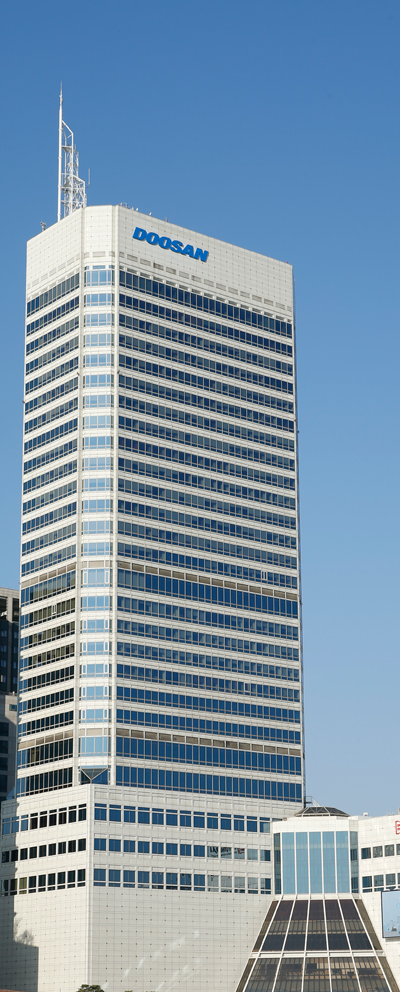
We started a new chapter in our history with the completion of Doosan Tower in the Dongdaemoon area, which is near Baeohgae in Jongro 4-Ga, the birthplace of Doosan.

2000 Established Neoplux
2000

Neoplux was established to make direct investments into other companies and provide relevant services, specializing in providing capital to start-up companies and assisting in corporate restructuring.

2001 Acquired Hankuk Heavy Industry (currently Doosan Heavy Industries & Construction)
2001

After creating a new growth engine based on the results of our restructuring, Doosan made yet another great leap forward in our history by acquiring Hankuk Heavy Industry, currently Doosan Heavy Industries & Construction, a globally recognized company specializing in power generation.

2003 Acquired Koryo Industrial Development (currently Doosan
Engineering & Construction)

2003

Since acquiring Koryo Industrial Development, Doosan Engineering & Construction has become even more cost competitive based on economies of scale, and sales revenue and income growth via synergistic effects.

2005 Opened DLI
2005

DLI (Doosan Leadership Institute) was established as place for nurturing the global talent that will lead our company into the next 100 years.

2005 Acquired Daewoo Machinery (currently Doosan Infracore)
2005

Reborn as a core affiliate that will lead Doosan’s ISB, Doosan Infracore continues to develop and launch new-generation products that function with top-class performance and reliability.

2005 Acquired water treatment business of the AES of the U.S. (currently
Doosan Hydro Technology)

2005

With the world’s top MSF competitiveness, Doosan Heavy Industries & Construction, obtained source technologies for key parts of the desalination plant or RO area by acquiring the water treatment business of the AES US (the Americas).

2006 Acquired Mitsui Babcock UK (currently Doosan Babcock)
2006

As part of its efforts to speed up globalization, Doosan Heavy Industries & Construction acquired Mitsui Babcock, a British source technology company for power generating facilities.

2006 Acquired IMGB Romania
2006

The Kvaerner IMGB (currently Doosan IMGB), the largest materials company for power generation facilities in Romania, became a new member of our Doosan family.

2006 Acquired Yonhap Capital (currently Doosan Capital)
2006_3

Doosan Capital began laying the foundation for becoming a global credit-specialized company when it joined Doosan.

Transformation into a Global Company (2007~)

Transformation into a Global Company (2007~)


With completed acquisitions of three business divisions of Ingersoll Rand including Bobcat, our global vision is now a reality as the Doosan brand becomes recognized around the world.  What began as a small Korean storefront stands today as a global industrial leader.


2007 Obtained 14 world’s No. 1 products (as of 2007)
2007

As of 2007, Doosan had a total of 14 products, including the of Doosan Heavy Industries & Construction’s desalination plant, designated by the MKE (former MOCIE of Korea) to be the world’s No. 1 products. Based on the world’s best technologies, they are currently performing well in the export market.

2007 Doosan Infracore acquired three business divisions of Ingersoll Rand US including Bobcat
2007

After successfully completing the M&A of small construction equipment business arms (Bobcat, Attachment, and Utility) of the global No. 1 brand, Ingersoll Rand US, Doosan Infracore has quickly risen to take 7th place in the world’s construction and machineries industry.

2007 Acquired CTI US and Yantai Machinery Ltd of China
2007

Doosan continues to quickly obtain technologies and tap into local markets with the acquisition of the CTI US, a company with source technology for the HCNG engine, and Yantai Machinery Ltd., a Chinese wheel loader company.

2008 Acquired Dong Myung Mottrol (currently Doosan Corporation Mottrol)
2008

Doosan acquired Dong Myung Mottrol, the nation’s top hydraulic machineries company. Doosan Corporation Mottrol has been quickly developing into a strong future growth engine for Doosan Corporation.

2008 Acquired Chung-Ang University foundation
2008

Doosan acquired the Chung-Ang University foundation in order to contribute to national and social development via social service activities. The new services communicate our scale and status as a dynamic global company.

2008 Doosan Infracore acquired ATL
2008

Doosan Infracore has acquired a German warehouse equipment manufacturer, Advanced Technology Lubben (ATL), and this move is part of Doosan’s bid to move into the European large-size warehouse market.

2009 Doosan Corporation converted into a business-running holding company
2009

Doosan Corporation has become a business-running holding company by satisfying the requirement for a holding company – the total value of the stocks of its subsidiary companies exceeding 50% of the assets of the company – from the 72nd ordinary shareholders’ meeting held on March 27 in Hotel Shilla located in Jangchung-dong, Seoul.

2009 Doosan Acquires Czech Power Generation Equipment Maker Škoda Power
2009

By acquiring Škoda Power of the Czech Republic, who possesses core technology for steam turbines, Doosan Heavy Industries & Construction secured core technologies for boilers, turbines, and generators, the three core facilities for power generation. Moreover, Doosan has completed a full line-up of boilers, turbines, and generators to enter the packaged product market of boilers, turbines and generators.

2010 Established Doosan Power Systems
2010

To advance into the EU and USA markets, Doosan Heavy Industries & Construction has established Doosan Power Systems which manages the power plant projects in these regions. The EU office and USA office of Doosan Power Systems are in Essen, Germany and New Jersey, USA, respectively. The company will integrate the boiler source technology of Doosan Babcock and the turbine source technology of Skoda Power to advance into the BTG (Boiler – Turbine – Generator) package markets of EU and USA.